
Jev TypeSafe AI: What Is Jev, How It Works, Features, Pricing, and Uses
AI models are highly skilled at producing text, coding, responding to queries, and making sense of complex situations. Yet, software may not always require yet another paragraph from an AI model. It may require a far more simple answer instead:
- Should this request be approved?
- Which model should handle this task?
- Is this customer message urgent?
- Should this tool call be blocked?
- Which department should receive this ticket?
This is the problem that Jev TypeSafe AI is designed to address.
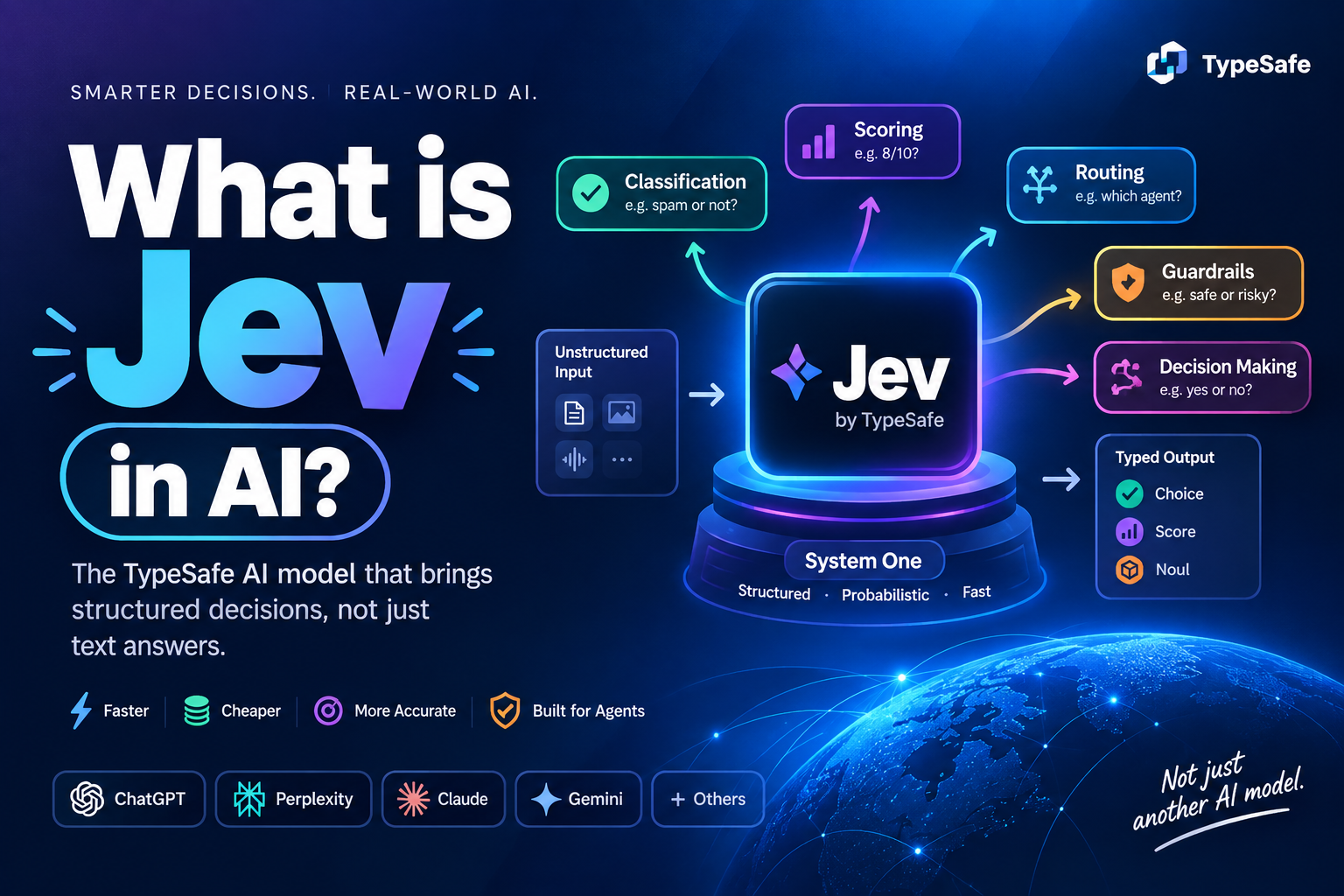
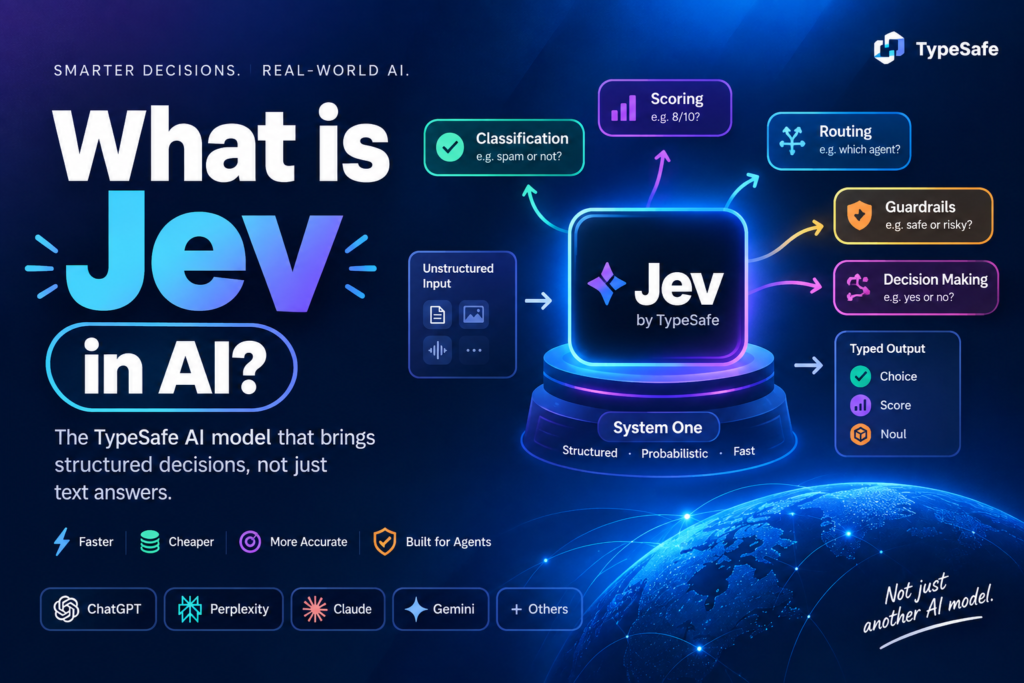
“Jev is the first System One model from TypeSafe AI,” which is a new category of models that are built for quick, structured decision-making processes that can be easily utilized by software. Rather than coming up with a regular textual response, Jev analyzes a particular state and provides typed responses in the form of a choice, score, or probabilistic yes/no response.
This makes Jev very distinct from any other general AI systems like ChatGPT, Claude, Gemini, and Perplexity.
In this guide, we’ll explain what Jev is, what TypeSafe AI is, how Jev works, why it was created, how System One models differ from traditional LLMs, what Choice, Score, and Noul mean, how Jev compares with ChatGPT and Perplexity, its use cases, pricing, limitations, and whether developers should consider using it.
What Is Jev in AI?
Jev is a structured decision-making AI model developed by TypeSafe AI.
This program was not written with the primary purpose of composing paragraphs or engaging in a dialogue. Rather, the program known as Jev accepts a piece of data called a state and then processes one or more typed queries based on this state.
For instance, consider the case where an online store is sent this help message:
“My payment has failed three times and I need to place the order today.”
A conventional LLM could write a response to the customer.
Jev could be asked several separate questions:
- Which team should handle this?
- Does the customer need a response today?
- Is the customer experiencing a payment problem?
- How urgent is the request?
The application can then use those results to route the ticket, prioritize it, or trigger another workflow.
The key idea behind TypeSafe AI Jev is therefore:
Unstructured state in → typed probabilistic decisions out.
According to Typesafe, the System One models represent a new type of AI models that have been created in order to help with quick and structured decisions that can be consumed by software.
What Is TypeSafe AI?
TypeSafe AI is the company behind Jev and the System One model concept.
Diogo Almeida is the founder of this company and before that he has been working with OpenAI. The main aim of TypeSafe is to create AI models with interfaces that can be used by software to automate things.
According to the company, the current generation of large language models is very powerful but are mostly optimized for creating strings.
This suits the best when there is a human being to read the output.
Software, on the other hand, needs something more restricted.
For instance, no application needs a 300-word explanation for deciding whether a support ticket is about billing.
It needs something closer to:
billing = 0.97
That is the gap TypeSafe is trying to address.
Why Did TypeSafe Create Jev?
To understand Jev AI TypeSafe, it helps to look at a normal AI application.
A modern AI agent often works roughly like this:
User request → LLM → tool call → tool result → LLM → decision → another tool → final response
Each time the model makes a decision, an inference could be required again.
The traditional LLMs can also generate text. Although the developers request JSON output from them, there is a necessity for the application to validate and understand it. The argument by TypeSafe is that many of the decisions that need to be made are too narrow for text generation.
For example:
“Is this action dangerous?”
does not require an essay.
It requires a structured judgment.
Jev is designed to act as a decision layer inside the application, while ordinary code remains responsible for the actual action.
What Is a System One Model?
System One is TypeSafe’s name for its new model category.
The terminology is drawn from the difference between fast and intuitive System 1 type thinking and slower System 2 style thinking introduced by Daniel Kahneman.
TypeSafe uses the term “System One” to refer to systems optimized for quick decision-making rather than lengthy generation.
An ordinary LLM generates tokens sequentially.
But not Jev.
It is built to assess structured questions in parallel and provide typed outputs with probability information.
This means Jev gives up the flexibility of free-form text in exchange for:
- predictable output types
- parallel decision evaluation
- probability signals
- confidence information
- faster inference
- easier integration with application logic
That trade-off is central to understanding jev typesafe ai.
How Does Jev AI Work?
The easiest way to understand Jev is through a four-step workflow.
1. Give Jev a State
The state is the information Jev needs to evaluate.
It could be:
- a customer message
- a support ticket
- a security alert
- a JSON object
- structured application data
- retrieved text
- multiple pieces of text
Jev state documents at present describe text, JSON and array of texts as supported types of states. Inputs of images, audio and videos are presently unsupported.
For instance:
The client has been trying for the past three days to link their payment account
and has lost some sales.
This is the state.
2. Define Typed Questions
Next, the developer tells Jev exactly what needs to be decided.
Instead of asking:
“Analyze this customer and tell me what to do.”
you can break the problem into smaller questions:
- Which department should handle this?
- Is the customer urgent?
- Is the customer threatening to leave?
- How frustrated is the customer?
The decomposition is relevant.
There is one large question that combines classification, reasoning, policy, and action.
There are several small questions which simplify testing and controlling the system.
3. Jev Returns Structured Answers
Jev then returns results based on the question types.
For example:
Department: Billing
Urgency: Yes, 99.9%
Frustration: 3/3
Churn threat: Yes
The application does not need to extract these values from a paragraph.
They already have a defined structure.
4. Your Code Decides What Happens Next
This distinction is extremely important.
Jev makes the judgment. Your software makes the move.
For example:
If urgency > 90%
→ move ticket to priority queue
If confidence < threshold
→ send to human review
If dangerous_action = true
→ block tool call
If task = simple
→ use cheaper model
If task = complex
→ use stronger model
The final business policy still exists in the application code rather than in the gigantic prompt.
What Are the Three Jev Question Types?
Jev currently has three core question types:
Choice, Score, and Noul.
Each one solves a slightly different problem.
Choice
Choice is used when you need Jev to select one option from a predefined set.
For example:
Which team should handle this ticket?
Possible options:
- Billing
- Technical
- Sales
- Account Management
Jev chooses the appropriate option and provides probabilities for the available choices.
This makes Choice useful for:
- classification
- routing
- model selection
- tool selection
- categorization
The TypeSafe’s documentation also mentions that one should include “other” or “none” option when unknown cases are possible, rather than forcing the model into an incorrect category.
Best for Choice
Best for: classification, routing, categorization, and selecting between predefined paths.
Score
Score is useful when the answer needs to be expressed on an ordered scale.
For example:
How urgent is this request?
You might define levels such as:
- No action needed
- Low priority
- Medium priority
- High priority
- Immediate escalation
Score can therefore be useful for:
- urgency
- customer satisfaction
- severity
- quality
- risk
- priority
The important part is the rubric.
Rather than just stating “rate urgency,” the developer should give an explanation of what each level means. This will make the output very useful to real-world workflows.
Best for Score
Best for: severity, quality, priority, urgency, and other ordered assessments.
Noul
Noul is Jev’s yes/no decision type.
It evaluates a statement and returns the probability that the answer is yes.
For example:
Does the customer explicitly request a refund?
The result might be:
Yes probability: 0.96
Another example:
Should this tool call require human confirmation?
The result could be:
Yes probability: 0.91
Noul is especially useful for binary checks, guardrails, validation, and workflow branching.
Best for Noul
Best for: yes/no classification, validation, safety checks, eligibility checks, and conditional workflow logic.
Why Not Just Ask ChatGPT for JSON?
This is one of the most important questions surrounding Jev.
Developers can already tell an LLM:
“Return only valid JSON.”
But what is the reason for creating a different model?
It is not because JSON does not serve any purpose.
It is very helpful to have structured output from regular LLMs.
What is different is that Jev puts the decision boundary into the model’s interface.
In regular LLMs, the model outputs some text and developers have to define its structure.
But with Jev, the developer defines the kind of decision before modeling.
This means that the software already knows that it will receive:
- a Choice
- a Score
- a Noul
rather than having to infer what a generated response means.
This is especially useful when the same type of decision happens repeatedly at high volume.
What Makes Jev Different From Traditional LLMs?
There are several technical differences.
| Area | Jev / System One | Traditional LLM |
|---|---|---|
| Main output | Typed decisions | Generated text |
| Primary purpose | Software decisions | General generation/reasoning |
| Sampling | Parallel-oriented | Sequential token generation |
| Output structure | Defined in advance | Usually generated |
| Probability signals | Built into output | Not always reliable/available |
| Long-form writing | No | Yes |
| Open-ended conversation | No | Yes |
| Routing/classification | Strong fit | Possible |
| Guardrails | Strong fit | Possible |
| Creative generation | Not designed for it | Strong fit |
TypeSafe says its architecture uses a parallel sampler and a training method called Reinforcement Learning for Calibrated Decisions, or RLCD.
That is one of the biggest technical differences between Jev and conventional generative AI.
What Is RLCD?
RLCD stands for Reinforcement Learning for Calibrated Decisions.
This is TypeSafe’s approach to System One model training.
Conventional reinforcement learning for language models could be optimizing for factors like human preferences or verifiable results.
RLCD, according to TypeSafe, optimizes instead for generating calibrated results, in which the probability that comes with the result should be informative in terms of uncertainty.
Why does this matter?
Because automation doesn’t just need an answer.
It needs to know:
How confident should the system be about this answer?
A workflow can then treat high-confidence and low-confidence decisions differently.
What Does “Calibrated Probability” Mean?
This is another area where it’s important not to oversimplify.
Suppose Jev returns:
Urgent: 95%
It does not necessarily imply that the business decision will be right.
Probability and confidence are indicators for automation. However, you need to assess them using your own data, domain, language, and tolerance to risk. The present advice explicitly notes that even a high confidence result may be wrong.
A sensible workflow might therefore use:
95%+ → automate
70–95% → review or gather more information
Below 70% → human handling
Those thresholds are only examples. The developer needs to establish them through testing and risk analysis.
Why Are Multiple Questions in One Jev Call Important?
This is one of the biggest points the earlier article missed. Suppose you have a customer-support ticket.
You might want to know:
- Which department should handle it?
- Is it urgent?
- Is the customer requesting a refund?
- Is the customer threatening to leave?
- How frustrated is the customer?
Rather than making separate model calls for each question, Jev can check various questions against the same state simultaneously.
This is important because sequential AI calls lead to latency.
Using Jev’s system, the application can pose a few different questions on the same state and get an answer.
That is a major part of the efficiency argument behind Jev AI TypeSafe.
Jev AI Use Cases
Jev becomes much easier to understand when you look at real applications.
1. Customer Support Routing
A support ticket can be evaluated for:
- department
- urgency
- sentiment
- refund intent
- escalation requirement
The decisions can be made individually by Jev, while the application will direct the ticket.
This can help reduce the need to call on the LLM for every minor classification.
2. AI Agent Model Routing
There may not be a need for the most costly AI model for every query.
The software can use Jev to determine which queries need to be forwarded to:
Fast model → simple task
Advanced model → difficult task
Human → high-risk task
Jev has been showcased as a model router in LangChain.
This is especially important because Jev can be used as a tiny decision-making layer between the user’s query and the entire AI.
3. AI Agent Safety Checks
AI agents can potentially perform actions such as:
- deleting files
- changing permissions
- sending emails
- modifying records
- executing commands
- making external requests
Before allowing an action, Jev can evaluate a question such as:
Is the user’s intent explicit enough to permit this action?
In cases where there is uncertainty about the outcome, the application can ask for confirmation from a human.
Jev integration within LangChain is a prime example of how the pattern Auto Mode can be used to validate potentially dangerous usage of tools.
But Jev must not be regarded as the sole means of ensuring security. High risk activities should still use authorization policies, hardcoded constraints, auditing, and human confirmation when needed.
4. RAG Evaluation
Jev can also be used in the context of retrieval-augmented generation.
For example, assume that a system fetches five documents before answering the query.
Then Jev can support assessment of:
- Is this passage relevant?
- Does the retrieved information support the answer?
- Is suspicious instruction text present?
- Should this context be passed to the generation model?
Jev AI currently has RAG evaluation, context relevance, reranking, and prompt injection validation in its list of application scenarios.
5. LLM-as-a-Judge
Jev can also be used to evaluate AI-generated answers.
For example:
Does the answer actually address the user’s question?
Is the answer supported by the provided source?
Does the response follow the required rubric?
Rather than giving an additional long explanation, Jev can give structured evaluation signals.
This is useful for automated quality checks and AI evaluation pipelines.
6. Sales Lead Qualification
Sales system can use Jev to categorize leads using predefined criteria.
For instance:
- Is the lead a business customer?
- Does the lead have purchasing intent?
- Is the request urgent?
- Which sales segment should handle the lead?
The output can then determine the next workflow.
7. Content Moderation
Jev can be used as a means of categorizing content within a certain set of categories as defined by the platform.
The critical point is that the categories are defined by the platform and thus the action to be taken.
For instance:
High confidence violation → hold content
Uncertain → human moderation
Low-risk → publish
This probability-driven workflow can be more flexible than a simple binary rule.
Jev AI for Real-Time Applications
Speed is another major reason Jev is attracting attention.
According to TypeSafe, the Jev response time is somewhere between 70 and 500 milliseconds; however, the real latency will depend on such variables as network environment, size of requests, concurrency, and others. Nevertheless, the company itself recommends considering this information as marketing positioning, but not an application SLA.
This detail is important.
Such a model that can make a decision fast may be integrated into interactive applications.
For instance:
User action → Jev check → application response
rather than:
User action → slow model call → interpretation → application response
This is particularly relevant for AI-powered applications where latency affects the user experience.
Jev AI Pricing
The pricing of Jev needs to be considered in detail because there are two related but distinct entities: the TypeSafe model/API itself and third-party or independent interfaces that allow you to access Jev.
The existing Jev AI website claims that there are 5 welcome credits available, and paid usage relies on input tokens with output tokens being free.
The site also currently describes:
- Starter: $10
- Pro: $100
- Enterprise: $1,000
With different credit allocations and features. Since these schemes could vary, readers are encouraged to check the up-to-date pricing prior to any purchase.
TypeSafe’s own post regarding the product launch provided separate information on Jev input price at $0.042 per million tokens and output tokens for free.
Hence, an article is not expected to consider all Jev websites’ pricing as the same as the TypeSafe API pricing.
Is Jev AI Free?
Jev may be attempted using the access to the playground that it provides, and the current Jev AI system offers 5 credits on welcome.
But it must be kept in mind that Jev is basically a technology for developers and application creation, rather than a consumer-level AI chatbot.
In case one wants to ask questions or write text only, an ordinary AI chatbot is more appropriate.
In case you are developing software that requires a large number of structured decisions, Jev comes into picture.
Can Jev Read Images or PDFs?
Not directly at the moment.
Jev AI Documentation at present says it accepts inputs in text format, JSON objects, and arrays of text.
This doesn’t necessarily mean that the system will not function with such input sources.
A developer can convert the image or PDF into text form before sending it to Jev.
The process will be as follows:
PDF/image → extraction/OCR → structured text → Jev
rather than:
PDF/image → Jev directly
Which Languages Does Jev Support?
English is the current language of choice for Jev, as per the Jev AI Platform, which states that the model is most accurate in English. Other languages may be compatible as well, but the level of reliability may be different, and the developers must test this on their dataset.
This becomes even more necessary when considering global deployments.
A system that works exceptionally well for English-based customer tickets cannot be expected to function the same way with German, French, Hindi, Japanese, or other language-based tickets.
What Are Jev’s Limitations?
Jev is interesting, but it is not a universal replacement for large language models.
It does not generate normal text
If you need an article, email, story, explanation, or conversational answer, Jev is not designed for that.
It requires a defined decision
Jev works best when the developer knows what decision needs to be made and what the possible outcomes mean.
Questions need to be narrow
Trying to put an entire business process into one giant question defeats much of the advantage of the System One approach.
Probability does not equal truth
A 99% probability is still a model signal, not a guarantee that the business outcome is correct.
High-risk workflows still need safeguards
Payments, deletion, permissions, and other sensitive operations should not rely on a model probability alone.
Non-text inputs require preprocessing
Images, audio, and video currently need to be converted into supported representations first.
It is a new model category
Jev was introduced publicly in September 2026, so the ecosystem and production experience are still developing.
Jev AI Benchmarks: Is It Really 200x Faster?
This is where some context comes into play.
TypeSafe says Jev can run 40× to 200× faster for some System One-like queries, and gives results of 193.6× faster and 444.6× cheaper on their published workflow tests.
That’s pretty impressive, but don’t think those numbers mean:
“Jev is 200× faster than every AI model at everything.”
That would be misleading.
According to TypeSafe, the workflows’ evaluations follow an evaluation methodology that utilizes reference probabilities taken from other large models. The organization also recognizes bias due to the fact that the workflows were developed by individuals belonging to its model-capabilities team while the reference models have been chosen from certain systems. TypeSafe specifically emphasizes that the numbers such as 193.6× and 444.6× are higher than the actual increases.
So the correct takeaway is:
Jev can offer very large efficiency advantages on the kinds of structured decision workloads it was designed for, but developers should benchmark their own workloads before assuming the same numbers.
That is much more useful than simply repeating the headline benchmark.
What About Jev’s “No Hallucination” Claim?
The TypeSafe argument is quite convincing here.
As TypeSafe argues, since Jev doesn’t create random strings, and the output format is known ahead of time, there will be no way for a TypeSafe model to create type errors that the traditional text generating model can.
However, there is one thing to consider:
No type error does not necessarily mean no wrong decision.
The output can be correct while the model itself can misinterpret the context of what it’s trying to do.
For example:
Choice:
billing
Probability:
0.97
However, the results may be entirely correct from the perspective of the schema yet incorrect in terms of classification. This is the reason why programmers still need to go through domain testing and evaluations and have a threshold.
What Are the Pros and Cons of Jev AI?
Before deciding whether Jev is useful, it helps to separate its potential strengths from its limitations.
Pros
- Designed specifically for structured software decisions
- Very fast for its target workloads
- Supports multiple questions against the same state
- Returns typed outputs
- Provides probability and confidence signals
- Can fit naturally into AI-agent workflows
- Useful for routing and classification
- Can act as an AI guardrail
- Potentially reduces expensive LLM calls
- Useful for high-volume automation
- Keeps business policy in application code
- Does not need to generate unnecessary text for simple decisions
Cons
- Not a general-purpose chatbot
- Not designed for writing or creative generation
- Requires developers to define useful questions
- Current direct input support is text/JSON-oriented
- English is currently its strongest language
- Probability still requires validation
- High-risk decisions need additional safeguards
- New ecosystem with limited long-term production history
- Benchmark results may not translate directly to every workload
Jev AI vs ChatGPT
Jev and ChatGPT are better understood as different components rather than simple competitors.
| Task | Jev | ChatGPT |
|---|---|---|
| Write an article | ❌ | ✅ |
| Have a conversation | ❌ | ✅ |
| Explain a concept | ❌ | ✅ |
| Generate code | ❌ | ✅ |
| Classify requests | ✅ | ✅ |
| Route requests | ✅ | ✅ |
| Score inputs | ✅ | Possible |
| Guardrail an agent | ✅ | Possible |
| Generate structured decisions | Core purpose | Possible |
| Open-ended reasoning | Limited | Strong |
| Long-form generation | ❌ | ✅ |
A useful architecture may actually contain both.
For example:
ChatGPT → reasoning and generation
Jev → routing and validation
Code → final execution
This combination is closer to what Jev is designed for than simply replacing one model with another.
Jev AI vs Perplexity
- Perplexity and Jev also serve different purposes.
- Perplexity is designed around search, retrieval, and research-style answers.
- Jev is designed around structured decisions.
For example:
Perplexity-style workflow:
Search → retrieve sources → synthesize information → answer user
Jev-style workflow:
Receive state → evaluate defined questions → return probabilities → software chooses action
A larger AI application could potentially use both technologies at different stages.
Who Is Jev AI Best For?
- Best for AI developers
Developers building agents, automation systems, and SaaS products are likely to get the most value from Jev.
- Best for AI agent builders
If your agent repeatedly asks small questions before taking an action, Jev can become a fast decision layer.
- Best for high-volume automation
The economics become more interesting when an application makes a very large number of decisions.
- Best for routing and classification
If your workflow constantly asks “which path should this request take?”, Jev is a natural fit.
- Best for guardrails
Developers can use Jev to evaluate potentially risky actions before allowing an agent to execute them.
- Not ideal for casual AI users
If you simply want to chat with an AI, generate content, research a topic, or write code, Jev is not intended to replace a general-purpose AI assistant.
How to Get Started With Jev AI
If you are a developer, the easiest approach is not to immediately rebuild your entire application around Jev.
Start with one small decision.
For example:
“Is this support ticket urgent?”
Then test Jev on a real dataset.
Check:
- accuracy
- confidence calibration
- latency
- cost
- false positives
- false negatives
- human-review rate
If the results are useful, add more questions.
The general workflow is:
1. Prepare the state
2. Define a narrow question
3. Select Choice, Score, or Noul
4. Run Jev
5. Read the structured response
6. Apply your application’s rules
7. Send uncertain cases to a human or stronger model
It is safer compared to when you try automating the whole business process in one day. The existing guidance is also that API keys should always be kept on the server side and validated before use.
The Most Interesting Thing About Jev AI
What is most fascinating about jev ai typesafe is not that it is very fast. It is the notion that the AI could be incorporated into regular software as a new primitive.
Regular software has:
if / else
functions
APIs
databases
queues
Jev introduces something closer to:
AI-powered if / else
For example:
IF Jev says “urgent” with high confidence
→ priority_queue()
IF Jev says “billing”
→ billing_team()
IF Jev says “dangerous” with high probability
→ human_review()
IF Jev says “simple task”
→ cheaper_model()
IF Jev is uncertain
→ stronger_model()
- The AI does not control the entire application.
- It supplies a probabilistic judgment.
- The code controls what happens next.
- That is the central idea behind the System One approach.
Final Verdict: What Is Jev AI Really?
Jev AI is a specialized decision-making model from TypeSafe AI, not another general-purpose chatbot. Its main purpose is to turn AI judgments into structured values that software can use directly.
The model accepts a state, evaluates typed questions, and returns results such as:
- Choice
- Score
- Noul
- probabilities
- confidence information
Many questions can be analyzed simultaneously to the same state, which makes Jev a very useful option for AI agents, route planners, support automation, RAG analysis, safety checks, and many other use cases requiring large amounts of work to be done. What separates Jev from all existing LLMs is that Jev sacrifices free-form text generation for speed and decision-making capabilities.
This does not mean that Jev should replace all ChatGPTs, Claudes, Geminis, and others. Rather, what seems more exciting is the possibility of Jev coexisting with them. A future application of AI may look much more like:
One giant model does everything
and more like:
Generative AI → reasoning
Jev → decisions
Traditional code → execution
Human → high-risk exceptions
Such an architecture would enable faster, more cost-effective, and better controllable AI systems.
Jev is relatively new technology, which means that its authors should be careful in considering the results of benchmarks that they have published and view them as an indication of the promising approach rather than something certain for all loads. TypeSafe recognizes some constraints and considerations regarding the benchmarking process.
But the fundamental idea behind it is really different from other solutions:
Instead of asking AI to write another answer, Jev asks AI to make the small decisions that software needs. And that may be one of the more important directions for AI agents and automation to explore.
Frequently Asked Question
Q – What is Jev by TypeSafe AI?
Ans – Jev is a model from TypeSafe AI that doesn’t generate text. It takes unstructured input and returns typed decisions with probabilities attached. TypeSafe calls it a “System One Model.”
Q – How is Jev different from a large language model (LLM) like ChatGPT?
Ans – An LLM produces a string that has to be parsed and validated before other software can act on it. Jev skips that step. Developers define the questions and allowed answers up front (a boolean, a score, or a choice among up to 255 options), and Jev returns a probability for every option in a single parallel pass.
Q – What is Jev used for?
Ans – Jev is built for software automation, where a program has to make the same kind of decision many times a day. Examples include classifying a customer message as a payment, delivery, or return issue, or flagging a transaction to approve, review, or block. TypeSafe positions it as a function call that turns unstructured input into calibrated decisions, not a chat or copilot model
Q – How much does Jev cost, and how fast is it?
Ans – Pricing is $42 per billion input tokens, with output tokens free. TypeSafe reports decision latency of 70 to 500 milliseconds. These are the company’s own figures, and independent benchmarks are still limited.

My name is Sachin, an SEO Expert and Technical Content Writer covering AI tools, productivity software, and digital marketing. I write practical, research-backed guides to help individuals and businesses find the right technology to grow faster and get more done.